|
Read
Articles about Variable Area Flowmeters
Learn more
at VAMeter.com !
The World Market for Variable Area Flowmeters
Flow Research is pleased to present The World Market for
Variable Area Flowmeters published in October of 2022. This study determines
the regional and worldwide market size and market shares of the leading
suppliers in 2019 and 2020 and forecasts market growth through 2024. It also
analyzes products from all of the primary VA suppliers, profiles the significant
worldwide suppliers; identifies the top industries, applications, growth
factors, and frontiers of research; and proposes market and product strategies.
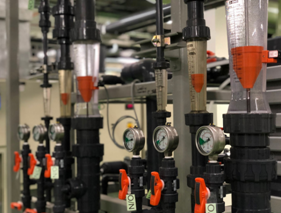 The
market for variable area (VA) flowmeters is growing steadily as suppliers
introduce improvements to meet the increasingly sophisticated needs of today’s
users, according to a new study from Flow Research.
The World Market for Variable Area
Flowmeters, Flow Research first, finds that worldwide VA meter revenues
totaled $280 million in 2019 and forecasts a compound annual growth rate (CAGR)
of 1.1 percent worldwide through 2024. The
market for variable area (VA) flowmeters is growing steadily as suppliers
introduce improvements to meet the increasingly sophisticated needs of today’s
users, according to a new study from Flow Research.
The World Market for Variable Area
Flowmeters, Flow Research first, finds that worldwide VA meter revenues
totaled $280 million in 2019 and forecasts a compound annual growth rate (CAGR)
of 1.1 percent worldwide through 2024.
The Variable
Area (VA) market has gone largely unexplored for many years, despite the fact
that this technology remains a popular choice for many end-users in a variety of
industries. VA meters are a good fit for simpler, low-cost solutions in gas and
liquid measurements. It is also a plus that most do not require power. Today, VA
meter suppliers are offering new materials of construction and new protocols for
those with an attached transmitter. In our study, we will explore the market
size and market shares along with industries and applications for this market.
Our main segmentation will be plastic, glass, and metal VA meters, with special
attention to purgemeters.
 About Variable Area Flowmeters About Variable Area Flowmeters
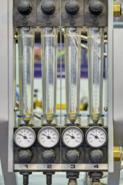
Most variable
area (VA) flowmeters consist of a tapered tube that contains a float. The
upward force of the fluid is counterbalanced by the force of gravity. The
point at which the float stays constant indicates the volumetric flowrate, which
can be often read on a scale on the meter tube. VA meter tubes are
made of metal, glass, and plastic. Metal tubes are the most expensive
type, while the plastic tubes are lower in cost. Metal tubes are used
for high-pressure applications.
Click to learn
more about

Other innovations
are also mitigating traditional VA design limitations to improve performance,
simplify installation and maintenance; and accommodate broader temperature and
fluid conditions. Enhancements noted in the report include:
·
Multiple tubes for measuring both gas and liquid
·
Rib-guided and
fluted metering tubes for more stable and accurate readings
·
Flow
adjustment/control valves on meter outlets and precision metering valves for
greater control and resolution, including for very low flow rates.
·
Suspended,
spring-loaded, and light-guided floats; guide rods to stabilize the floats;
orifice floats; low pressure drop and float damping mechanisms, and other float
design improvements
·
Integral
orifice, built-in flowtube cleaners, adjustable flow alarms, and other design
features that compensate for contamination, viscosity, and density, even with
very low flows
·
Smaller meters,
flowtube assemblies that can be quickly interchanged without disturbing the
piping, isolation valves, a variety of mountings, more readable scales
 While most VA meters can be read manually, some also contain
transmitters that generate an output signal that can be sent to a controller or
recorder. While VA meters should not be selected when high accuracy
is a requirement, they do very well when a visual indication of flow is
sufficient. They are very effective at measuring low flowrates and
can also serve as flow/no-flow indicators. VA meters do not require
electric power and can safely be used in flammable environments. While most VA meters can be read manually, some also contain
transmitters that generate an output signal that can be sent to a controller or
recorder. While VA meters should not be selected when high accuracy
is a requirement, they do very well when a visual indication of flow is
sufficient. They are very effective at measuring low flowrates and
can also serve as flow/no-flow indicators. VA meters do not require
electric power and can safely be used in flammable environments.
One important
development for variable area flowmeters is the development of
meters with a transmitter output. The HART protocol is available on
some meters. This turns the VA meter into more than a visual
indicator and makes it possible to do control and recording. A class
of VA meters called purgemeters have been developed to handle a variety of low
flow applications. Other areas of research include float design and
materials of tube construction, especially metal.
|